


Are you shopping for suitable gym flooring for your home or facility? Here’s why you should consider investing in interlocking rubber tiles to cover your floor space.
Table of Contents
- What Can I Use Interlocking Floor Mats For?
- What Are the Benefits of Interlocking Tiles?
- How Do Interlocking Tiles Connect?
- What Are Interlocking Tiles Made Out Of?
- Sprung Gym Flooring Interconnecting Mats
- Connect With Gym Flooring
What Can I Use Interlocking Floor Mats For?
Pandemic lockdowns changed the way we live. Though things have mostly returned to normal, many people have seen the value in creating a place to work out in their homes or outdoor spaces. Interlocking foam mats and tiles can help you make your home or living space multifunctional.
Home Gyms

Working out at home can be quite convenient, but it does have drawbacks. Most flooring in our homes is not designed to withstand heavy exercise equipment. Machines or weights can scuff your floors or even crack floorboards. Your floors may not provide a comfortable surface to exercise on. Hardwood provides minimal shock absorption, and carpeting might not offer enough traction to prevent slips. You can always use a yoga mat, but this limits your exercise space. Using interlocking floor mats is an excellent option for safe at-home workouts.
If you intend to exercise at home regularly, you might consider building a home gym in a spare room, garage, or garden. Wherever you build your gym, adding matting to the space makes it more comfortable and can minimise damage to your flooring. Rubber or foam tiles are a relatively inexpensive and easy way to ensure your matting covers your exact floor space without gaps or bunching.
Children’s Play Spaces

Whether you have a baby who is just learning to crawl or walk or young kids who love to run, jump, and climb, you want your little ones to be able to play safely and still have fun. Having a space set aside just for them allows them to explore and be independent without risking serious injuries.
Inside or outside, interlocking foam mats can provide peace of mind while your children play. Foam jigsaw matting tiles, like those in a nursery or reception classroom, can be used in indoor playrooms to help prevent slips and cushion falls while kids play. If you have climbing equipment in your garden, we offer outdoor rubber tiles that can be placed underneath swing sets and jungle gyms to create a safer environment for play. Both options are affordable and easy to install yourself.
Gardens and Patios

Outdoor rubber tiles are not limited to use under your child’s climbing equipment. If you want to create a space where you can enjoy sitting in your garden in nice weather or host friends for a barbecue, you can also use interlocking rubber tiles to create a patio. This will provide a flat surface where you can comfortably sit at tables and chairs, and you don’t have to worry about the ground under the furniture becoming muddy every time it rains.
If you drop a glass or plate, the shock-absorbent rubber surface will help prevent it from shattering. These tiles don’t require adhesive, so you can store them during the winter and bring them out again in the spring. This option may also be more affordable and easier to do on your own than building a wooden deck or laying brick or stone for a patio.
SHOP GARDEN AND PATIO FLOORING
What Are the Benefits of Interlocking Tiles?
Modular tiles help you customise the matting to your space and avoid wasting material. However, not all matting tiles are created equal. Especially if you are installing the flooring yourself, make sure you are using tiles that can connect to each other. You will achieve much better results and save time and effort.
Here’s why:
Interlocking Floor Mats Are Easy to Install
Modular matting tiles allow you to install matting on your own without the help of professionals. Often, you won’t even need another person to help you carry them. Some tiles may require adhesive, which can be messy and challenging to do correctly. If you accidentally lay a tile in the wrong spot, you will have to pry up the adhesive or use a solvent to remove it. Gym Flooring’s tiles do not require adhesive, so they are simple to install and remove.
Interlocking Mats Remain Stable
Since it’s not ideal to use adhesive, interlocking tiles are a great way to ensure that your tiles won’t move around, even when you are in the middle of an intense workout or the kids are playing rough. Because these tiles lock together, you can’t move one by itself. If a single tile is going to shift, the entire floor would have to change with it. Our tiles have enough heft that they are difficult to push out of place just by running or jumping on them — especially when locked together. This helps to prevent slips and falls during exercise and play.
You Can Easily Replace Interlocking Floor Mats
Replacing an entire room’s flooring because a small section got damaged is expensive and time-consuming. With interlocking foam floor mats, you can remove the damaged ones and leave the rest of the floor in place. Instead of ripping up and replacing a whole floor, you only have to replace one or two tiles, which is easy to do on your own. This is a great feature if you have young children in the house.
Adding foam tiles to your child’s playroom can protect hardwood floors and carpets from sticky food or drink spills, scuffs, and rogue craft supplies like markers or scissors. Not only will the foam mat be easier to clean, but if your child manages to damage one permanently, you can swap out the affected tiles for new ones. You might even consider keeping a few extra on hand from the start.
How Do Interlocking Tiles Connect?
Interlocking foam tiles are uniquely designed to stay together when you’re using them while coming apart easily when you’re ready to remove or replace them. There are a couple of different designs you can choose from when installing interlocking tiles for use in your home.
Jigsaw Design

When you think of interlocking mats, jigsaw mats probably come to mind. They are generally seen in reception classrooms, nursery schools, or other facilities catering to younger children. They are most commonly made from lightweight but durable EVA foam and come in a rainbow of bright colours. These types of tiles aren’t strictly limited to children’s spaces. Durable rubber tiles ideally suited to use in home gyms may also come with Jigsaw puzzle-style connections.
To install this type of matting tile, match up the tabs on blanks between two pieces and press down along the seam until they fit snugly together. Despite the simple design, these types of foam mats are unlikely to come apart unless you purposefully pull them apart. If you’ve ever assembled a jigsaw puzzle, you’ll understand how hard it is to pull puzzle pieces apart laterally. This allows for an easy manufacturing process and, in turn, a relatively inexpensive product that still performs remarkably well.
Hidden Connector Pieces

If you want your flooring to look more polished and streamlined, there are several options for tiles with hidden connector pieces. Modular PVC flooring may use a tab and loop system to create a sturdy hold. One edge of the tile will have the tabs cut into the underside, while the other edge has a series of loops that jut out from the side of the tile. These tabs and loops fit together like puzzle pieces on the underside, but the tiles have straight edges on the surface that are more visually appealing.
Rubber tiles might use interlocking channels or quad blocks. Interlocking channels use a hooked piece on one tile to hide under the edge of another tile and create a firm hold. Quad lock tiles will have notches on each corner. A square connector piece fits around all four notches to hold them together when four corners are put together.
SHOP KONNECTA RUBBER GYM TILES
Connector Pins
Some rubber floor tiles are designed to be joined with connector pins. These tiles feature pre-drilled holes that line up with each other. Metal or plastic pins are inserted into these holes to hold the tiles together. Pins are usually ridged like screws to create more traction and provide a stronger connection between the two tiles.
Connecting rubber tiles with pins does not require special tools or expertise; you can simply push the two tiles together with your hands, and you will still have a secure fit that you don’t have to worry about coming apart, even when subjected to vigorous activity.
What Are Interlocking Tiles Made Of?
Modular interlocking tiles are available in many different materials. Different materials will provide different benefits depending on how you intend to use the tiles. If you are using tiles as matting for a children’s playroom or a home gym, you want to look for excellent shock absorption and slip resistance. If you are using tiles outside, you want a material that is resistant to the elements and won’t pollute the surrounding environment.
Rubber

Rubber tiles are best suited for home gyms and commercial fitness centres where you intend to use heavy equipment — like large weights or running machines — or outdoors. Rubber is a highly durable natural material that provides excellent shock absorption. Rubber quickly regains its shape after being subjected to force, providing excellent bounce. It won’t permanently dent under the weight of exercise equipment or patio furniture, and it is tough to puncture or tear.
Many rubber tiles are made from recycled materials like old vehicle tires. Rubber is non-toxic, water resistant, and won’t fade after prolonged exposure to UV light. It is easy to clean with a regular broom, damp cloth, and gentle cleanser.
EVA Foam

EVA foam mats are great for children’s indoor playrooms and home workout spaces where you will not be using heavy equipment. EVA is a firm but lightweight closed-cell foam. It provides less of a bounce than rubber, but it has excellent cushioning. In addition to protecting against injury in the case of falls or slips, it also reduces strain and fatigue.
Many EVA foam matting tiles are textured to improve traction and make slips less likely. However, it is easier to rip or puncture with sharp objects.
EVA foam tiles are not ideal for home gyms with heavy machines or lifting benches, but they are great for yoga, pilates, and aerobics. Because this foam is so light, it is straightforward for one person to install it. It is also easy to remove and store when not in use. This is ideal if you live in a small flat or home and don’t have room for a permanent home gym but want to add an extra layer of padding to your floor while you exercise.
PVC

PVC is a very common type of plastic. It comes in both a rigid, unplasticised form and a flexible, plasticised form. It is incredibly durable and lightweight enough to install PVC tiles yourself. In addition, it is also a highly shock-absorbent material and is frequently used in vehicle dashboards to prevent serious injuries in the event of a crash.
Modular PVC tiles provide a flat, secure surface for activities. These might not be the ideal matting to lay over a hardwood floor, as it is rigid enough to scratch the hardwood. However, it is an excellent choice to lay over concrete garage floors or carpeted flooring to provide better traction and comfort in your home gym and is an ideal material for outdoor space.
PVC is naturally water resistant, and most tiles are perforated to promote drainage and treated to be UV-resistant. If you are placing it under climbing equipment more than half a metre tall, you should add foam or rubber padding underneath to meet the UK critical fall height ratings.
Sprung Gym Flooring Interconnecting Mats
You’ve come to the right place if you’re looking for interlocking tile matting. We offer a wide variety of interlocking floor tiles suitable for indoor and outdoor activities.
Foam MMA and Play Mats

Our EVA foam interlocking puzzle tiles are ideal for children’s soft play areas and martial arts studios. They are made from dense but lightweight closed-cell foam with a high-traction textured surface inspired by traditional Japanese mats used in martial arts for centuries. We offer foam play mats in both 20mm thickness and 40mm thickness. Two reversible colour options are available: black and grey or red and blue. The 20mm option is critical fall height rated up to 1.7 metres.
Rubber Gym Flooring Tiles

Our rubber jigsaw puzzle mats are available in 10mm or 15mm thicknesses and are 1000mmx1000mm. The solid black and the Fleckz range are made from 100% recycled rubber granules. Not only do they provide excellent shock absorption for functional training and lighter-impact fitness activities, but they also protect your subflooring from damage.
SHOP INTERLOCKING RUBBER GYM MAT TILES
Safety Playground Rubber Tiles for Outdoors

Safety rubber playground tiles are 30-40mm thick and are available in black, green, and red. They connect via quad-lock connectors. They are ideal for back garden play areas or patios. They are critical fall height rated according to EN 1177 standards and provide excellent slip-resistance, shock absorption, and anti-fatigue properties. You can also use them to build a high-impact home workout space in your garden, garage, or shed. They measure 500mmx500mm.
PVC Modular Sports Flooring
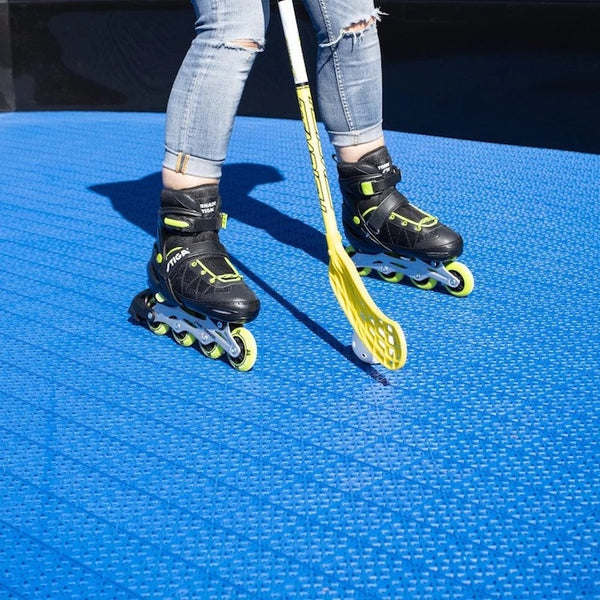
We recommend our modular PVC flooring for sports like basketball, volleyball, football, badminton, roller sports, handball, and rugby. Available in red, blue, and green, the tiles are 1.5 cm thick and measure 250mmx250mm. They lock together using tab and loop connection points. The mat finish prevents light reflections and glare, and they are designed with a micro-texture surface to provide high levels of traction and slip resistance.
They are certified by numerous National and International Sports Federations for indoor and outdoor athletics use. Their perforated design is conducive in outdoor settings, allowing water to drain off the tiles instead of pooling on the surface.
Connect with Gym Flooring
Interlocking floor mats are a user-friendly, low-maintenance floor option for fitness, play and multi-purpose use. The most popular options are made from rubber or foam and come in various self-locking designs to make the installation easier while adding extra stability. Whether you opt for rubber interlocking floor mats, PVC tiles or foam puzzle mats, they all have one thing in common: versatility. They are suitable for a wide range of uses and can work in home and commercial fitness spaces, home play areas, and outdoor recreation spaces.
You may also be interested in reading:
Jigsaw Mats: The Final Piece of the Puzzle for At-Home Workouts