
 Sale
Sale20mm PRO Rubber Gym Flooring Tiles – Smooth Top Surface - UK's Top Rated
£34.95£42.44Unit price /Unavailable
![Black 20mm PRO interlocking edge ramp strip]()
![Black 20mm PRO interlocking quarter-circle corner ramp piece]() Sale
Sale20mm PRO Interlocking Gym Tiles – Connection Inserts Included
From £14.01£18.44Unit price /Unavailable-
Sold outSale
15mm Sprung PRO Gym Flooring - Sprung Rubber Heavy Duty
£30.39£39.98Unit price /Unavailable -
![Corner of a black 30mm Sprung PRO rubber gym floor tile]()
![Black 30mm Sprung PRO rubber edge ramp strip]() Sale
Sale30mm Sprung PRO Gym Floor Tile - Rubber Heavy Duty Gym Flooring
From £31.34£41.24Unit price /Unavailable -
Sold outSale
-
Sale
-
Sale
-
![Edge of a 20mm Konnecta Velvet Black mat showing the rubber base]()
![20mm Konnecta Velvet Black edge ramp at an angle]()
![20mm Konnecta Velvet Black corner ramp with blue connector]() Sale
Sale 
![Black outdoor 30mm rubber tile, front view]()
![Black outdoor 20mm rubber tile, front top view]()
![Green outdoor 30mm rubber tile, front view]()
![Green outdoor 20mm rubber tile, front top view]()
![Red outdoor 30mm rubber tile, side diagonal view]()
![Red outdoor 20mm rubber tile, front view]() Sale
SaleEasiFit Heavy Duty 50cm x 50cm Gym Flooring Mats – Smaller Size for Easy Fitting -3 Colours
From £8.30£10.93Unit price /Unavailable-
Sale
-
Sale
20mm Konnecta Snowflake Self-Locking Gym Flooring Mat
£54.14£65.74Unit price /Unavailable -
![Light grey 20mm Konnecta Fleckz fitness tile from above]()
![Light grey Konnecta Fleckz edge ramp with dimensions]()
![Light grey Konnecta Fleckz L-shaped corner piece at an angle]()
![Blue fleck Konnecta Fleckz edge ramp]()
![Blue fleck Konnecta Fleckz quarter-circle corner from above]()
![Teal fleck Konnecta Fleckz edge ramp]()
![Teal fleck Konnecta Fleckz L-shaped corner piece]()
![Dark grey Konnecta Fleckz edge ramp]()
![Dark grey Konnecta Fleckz quarter-circle corner piece]()
![Red fleck Konnecta Fleckz edge ramp]()
![Red fleck Konnecta Fleckz L-shaped corner piece]()
![Close-up corner of a blue fleck 20mm Konnecta Fleckz fitness tile]()
![Teal fleck 20mm Konnecta Fleckz fitness tile from above]()
![Edge of a dark grey 20mm Konnecta Fleckz fitness tile]()
![Edge of a red fleck 20mm Konnecta Fleckz fitness tile]()
![Green fleck 20mm Konnecta Fleckz fitness tile from above]() Sale
Sale -
Sold outSale
-
Sale
-
Sold outSale
43mm Acoustic Gym Flooring Tiles – Decibel Collection
£68.85£90.59Unit price /Unavailable -
Sale
60mm Acoustic Gym Matting Tiles – Decibel Collection
£114.95£151.25Unit price /Unavailable









55,000+ UK home gyms built on Sprung flooring · Rated 4.9/5 from 550+ reviews · 10-year warranty
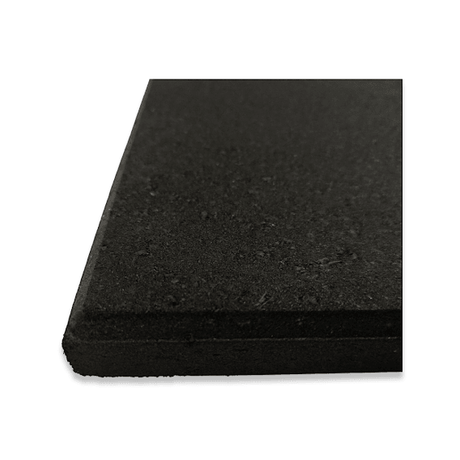
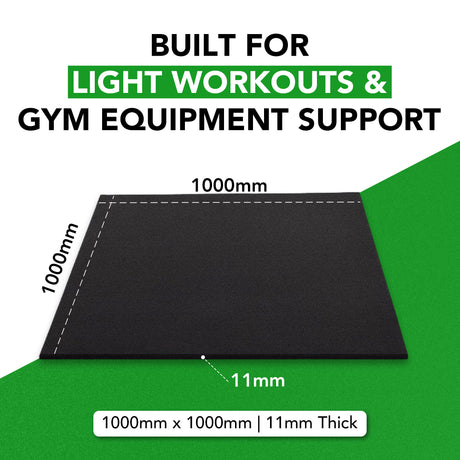
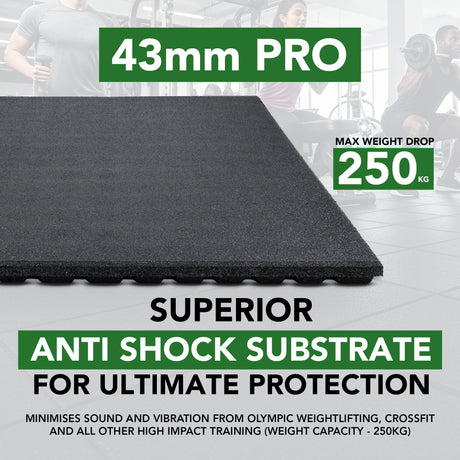
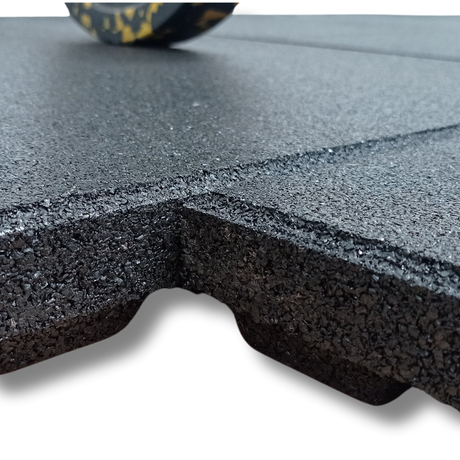
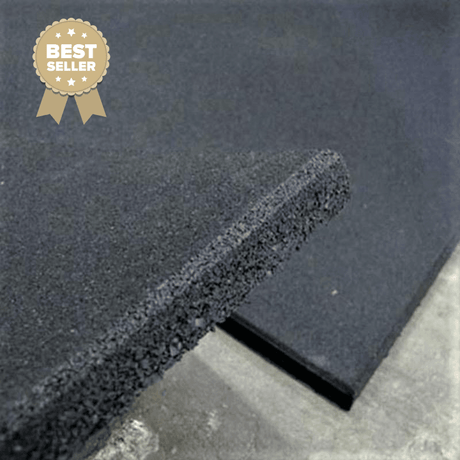
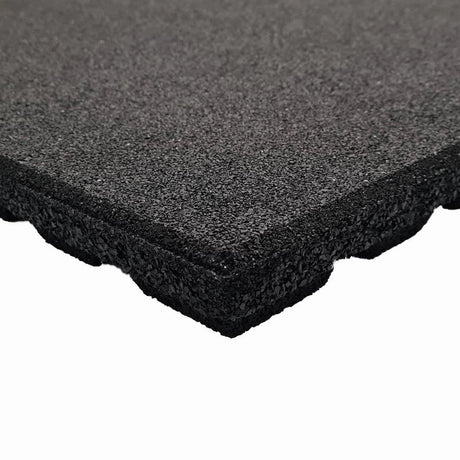
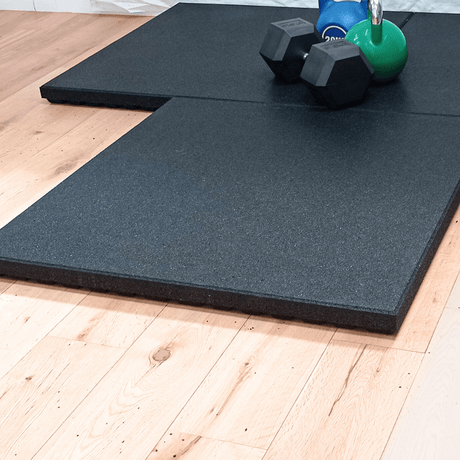
Rubber gym tiles are 1m x 1m solid rubber squares that lock or butt together to form a hard-wearing training floor. Sprung's PRO range runs from the 11mm PRO tile at £29.44 to the 43mm PRO anti-shock tile at £70.75, and the 20mm PRO (£34.95) is the default choice for home gyms.
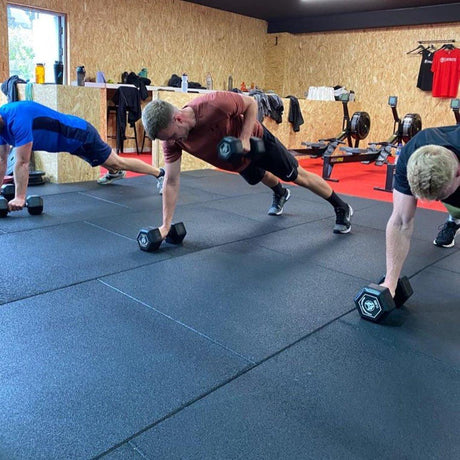
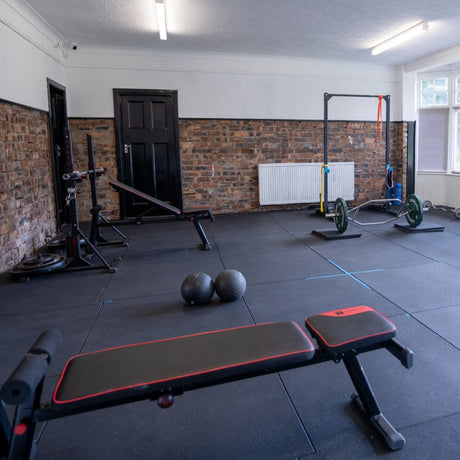
Create a safer, quieter and more durable training space with rubber gym floor tiles designed for home gyms, commercial fitness facilities, strength areas and functional training zones. Available in multiple thicknesses, finishes and fitting systems, rubber tiles help protect the subfloor while providing a stable, slip-resistant surface for exercise equipment, weights and everyday workouts.
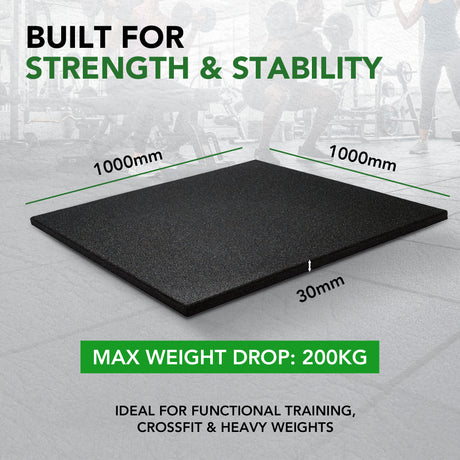
Our range includes straight-edge PRO tiles, hidden-connection Konnecta designs, coloured Fleckz finishes and thick anti-shock options for demanding weight-training areas. Most tiles measure 1m x 1m, allowing larger spaces to be covered quickly while keeping cutting and joints to a minimum.
Why Choose Rubber Gym Tiles?
Rubber is one of the most practical materials for gym flooring because it combines durability with impact absorption, grip and straightforward maintenance. Unlike hard domestic flooring, it creates a more forgiving layer between the user, equipment and structural subfloor.
Rubber gym tiles can be used beneath:
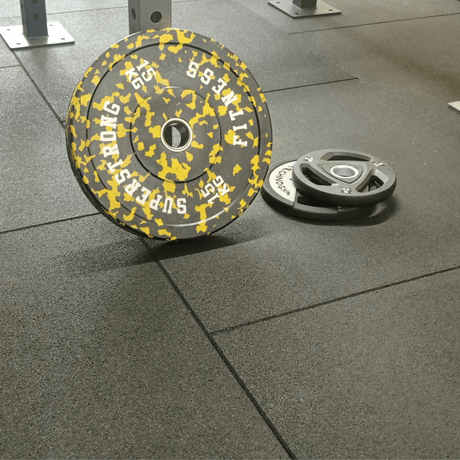
- Dumbbells, barbells and kettlebells
- Squat racks and weight benches
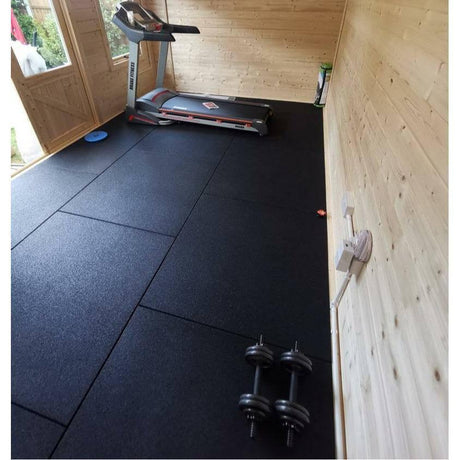
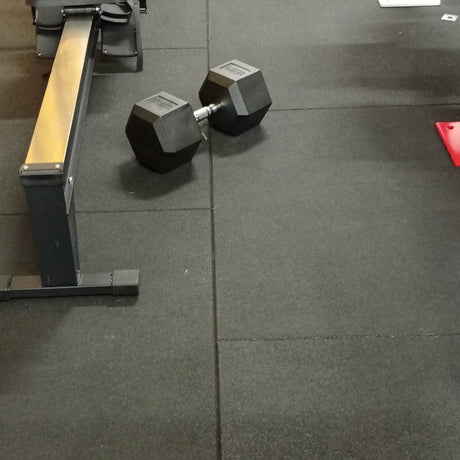
- Treadmills, exercise bikes and rowing machines
- Cable machines and strength equipment
- Functional training stations
- Bodyweight, circuit and HIIT areas
The dense construction helps spread equipment loads while reducing damage caused by dropped or repeatedly placed weights. It also improves traction beneath equipment feet, helping machines and benches remain stable during use.
What Thickness of Rubber Gym Tile Do You Need?
The correct thickness depends on the type of training, the weight being used and how frequently equipment may be dropped. Choosing solely by price can leave the floor underprotected, while an unnecessarily thick tile may add cost and height where it is not required.
As a practical guide:
- 11mm tiles suit light-impact exercise, cardio machines and weights up to approximately 100kg.
- 15mm tiles work well for general fitness, lighter free weights and equipment loads up to approximately 110kg.
- 20mm tiles are a versatile choice for most home gyms, PT studios and general strength areas, supporting weights up to approximately 140kg.
- 30mm tiles provide additional impact protection for heavier strength training and loads up to approximately 200kg.
- 43mm tiles are suited to heavy free-weight areas, CrossFit-style training and weights up to approximately 250kg.
- 53mm tiles provide increased cushioning for very heavy lifting and loads up to approximately 300kg.
- 63mm tiles offer maximum protection for specialist powerlifting and Olympic lifting zones, supporting loads up to approximately 350kg.

These figures should be used as a general selection guide. The way a weight is lowered or dropped, the construction of the subfloor and the frequency of impact must also be considered. Dedicated free weights flooring or thick gym mats may be more appropriate where repeated heavy drops are expected.
Rubber Tiles for Home and Garage Gyms
For most home gym flooring projects, 15mm or 20mm rubber tiles provide a useful balance of protection, comfort and cost. They are suitable for benches, racks, moderate dumbbells, kettlebells and compact cardio equipment without making the room feel overly cushioned.
Garages often need a more robust specification because equipment sits directly above concrete and the space may be affected by cold, condensation or dirt brought in from outside. A 20mm or 30mm tile is normally a practical starting point for garage gym flooring, with thicker anti-shock tiles used beneath dedicated lifting stations.
Rubber can be laid over a clean, dry and reasonably level concrete base. It is moisture-resistant, but existing damp problems should be resolved before installation rather than trapped beneath the new floor.
Commercial Rubber Gym Flooring Tiles
Commercial gyms require flooring that can withstand high footfall, equipment movement and repeated daily use. Rubber tiles make it possible to specify different thicknesses across the facility without changing the overall appearance of the floor.
A cardio zone may only require a thinner tile beneath treadmills, bikes and cross trainers, while a free-weight area benefits from 30mm, 43mm or thicker protection. This zoned approach can control costs while placing the greatest impact resistance where it is genuinely needed.
Within commercial gym flooring projects, 1m x 1m tiles also make future maintenance simpler. Individual tiles can be lifted or replaced if a localised area is damaged, rather than removing an entire rolled floor.
Shock, Noise and Vibration Reduction
Rubber tiles soften the contact between weights, equipment and the structural floor. This can reduce sharp impact noise, equipment vibration and the echo commonly experienced in garages, studios and large commercial rooms.
Thickness matters. A thin tile may reduce general footfall and machine noise, but it will not isolate heavy barbell drops in the same way as a 43mm or 63mm anti-shock tile. Where sound transfer is a major concern, particularly in an upstairs gym or attached property, consider soundproof flooring mats and assess the complete floor build-up rather than relying on the surface tile alone.
Flooring can reduce impact transmission, but it cannot guarantee that heavy lifting will be inaudible in adjoining rooms or neighbouring properties.
Straight-Edge or Interlocking Rubber Gym Tiles?
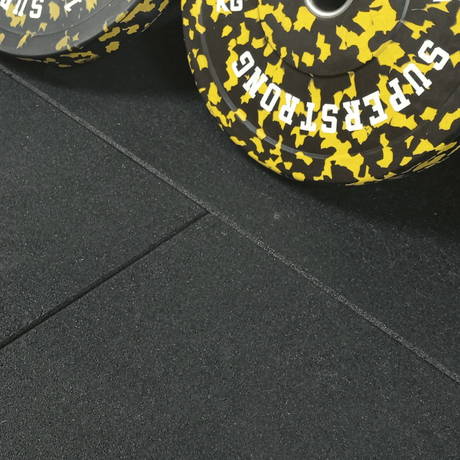
Straight-edge tiles are usually fitted closely together using compression, perimeter restraint or adhesive. Their clean edges create a uniform floor and make them suitable for permanent wall-to-wall installations.
Interlocking rubber gym tiles are useful when easier DIY fitting, future lifting or a modular layout is important. Our Konnecta system uses concealed connection inserts beneath the tiles, creating the appearance of a straight-edge floor while helping adjacent tiles remain aligned.
Interlocking designs can be particularly useful in rented premises, multipurpose rooms and home gyms where the layout may change later.

Rubber Gym Tiles or Rubber Flooring Rolls?
Tiles offer the greatest choice of thickness and are generally easier to handle, position and replace. They suit smaller rooms, irregular layouts, heavy lifting zones and projects where installation will be completed without a professional fitter.
Rubber gym flooring rolls use fewer joints and can be economical across large cardio, studio and general fitness areas. However, rolls are heavier to move, more difficult to position and normally available in thinner specifications.
A gym does not have to use one format throughout. Rolls may cover cardio or circulation spaces, while thicker tiles protect free-weight and functional zones.
Exercise Flooring Tiles with Anti-Slip Properties
Rubber gym tiles have a naturally grippy surface that supports secure footing during strength training, circuits and machine-based exercise. This does not remove the need for regular cleaning. Dust, chalk, moisture and cleaning residue can all affect surface traction if allowed to build up.
The slight resilience of rubber also makes it more comfortable beneath the feet than concrete or rigid domestic flooring. It provides enough cushioning to reduce harshness while remaining stable beneath racks, benches and exercise machines.
Easy DIY Installation
Most rubber tiles can be installed without specialist equipment. The base should be clean, dry, level and free from loose dust or debris before work begins.
Tiles can be cut using a sharp utility knife or suitable cutting tool and a straight edge. A brick-bond layout can help distribute joints and create a professional finish. Depending on the room dimensions and intended use, tiles may be loose-laid under compression, secured using interlocking connectors or bonded with an appropriate flooring adhesive.
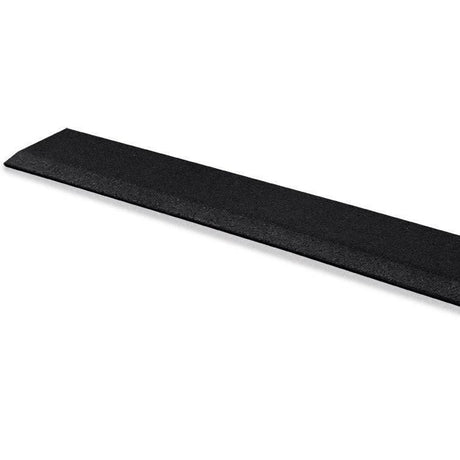
Matching ramps can be added to exposed sides to create a neater transition and reduce the risk of catching a raised edge.
Cleaning and Maintaining Rubber Gym Tiles
Routine care normally involves vacuuming or sweeping away grit, followed by damp mopping with a diluted, neutral-pH cleaner. Avoid harsh acidic products, strong solvents and excessive water.
Wipe up sweat and spills promptly, particularly around machines and free-weight stations. New rubber flooring may initially have a characteristic rubber smell, but ventilation usually allows this to reduce after installation.
With the correct thickness, installation and cleaning routine, rubber gym floor tiles provide a long-lasting surface that can adapt to everything from a compact workout corner to a complete commercial strength facility.
You may also be interested in reading:
Rubber Tiles vs Rubber Rolls: Which Gym Flooring Is Right for You?

Home Gym Flooring vs Commercial Gym Flooring: What’s the Difference?

