Published by Sprung Gym Flooring · August 2026
The UK Home Gym Report 2026
Published by Sprung Gym Flooring · August 2026 · gym-flooring.com Data drawn from 55,000+ UK home gym installations (2020–2026), the company's complete order history analysed for this report, and UK search data. Free to cite with attribution — see "Using this data" at the end.
Key findings
Norwich is Britain's home gym capital. Adjusted for population, Norwich residents built more home gyms in the last 12 months than any other UK city — around 46 orders per 100,000 residents, eight times London's rate.
Black Friday, not New Year, is peak home gym season. November 2025 was the single busiest month for home gym building — 6% ahead of January 2026, the traditional peak.
The January rush is real but mild — and summer now matches it. May and June 2026 combined outsold January and February by 8%.
Britain's home gyms are getting bigger. The average order value reached a record high in 2026 — 22% higher than during the 2021 lockdown boom — as one-mat purchases give way to full-room builds.
85% of rubber gym tiles sold are 20mm thick. Only 7% are the extra-thick 30mm+ tiles — evidence that most buyers now floor the room in standard thickness and reserve heavy-duty tiles for lifting zones.
Home gym demand is growing again. After three flat years following the lockdown boom, revenue rose 16% in 2025 and is up a further 6% in 2026 to date.
HYROX has transformed fitness search behaviour. UK searches for "HYROX" grew from a few dozen a month in 2020 to more than 150,000 a month at the 2026 peak — a nine-fold rise in the last three years alone.
AI assistants are the new shop window. Microsoft's Copilot alone cited Sprung Gym Flooring's guides 13,400 times in three months (May–August 2026), answering flooring questions directly inside AI conversations.
1. The second wave: home gym demand, 2020–2026
The lockdown era built Britain's first wave of home gyms: orders at Sprung Gym Flooring nearly tripled between 2020 and 2021 (up 174%). What followed was not a collapse but a plateau — annual sales held within a few percent of the same level through 2022, 2023 and 2024 as the market digested the boom.
2025 broke the pattern. Sales rose 16.4% year on year, and 2026 is running a further 6% ahead of 2025 over the same months. The home gym did not turn out to be a lockdown fad; it became a permanent fixture of British housing, now growing on fundamentals — hybrid working, gym membership costs, and the fitness culture examined later in this report.
2. Britain's home gym capitals
Ranked by orders per 100,000 residents over the 12 months to August 2026, the cities building the most home gyms per person are:
| Rank | City | Orders per 100,000 residents (approx.) |
|---|---|---|
| 1 | Norwich | 46 |
| 2 | Reading | 40 |
| 3 | Preston | 36 |
| 4 | Cambridge | 27 |
| 5 | Bristol | 23 |
| 6 | Nottingham | 23 |
| 7 | Southampton | 23 |
| 8 | Derby | 19 |
| 9 | Solihull | 19 |
| 10 | Glasgow | 18 |
London leads in absolute volume — more orders than the next four cities combined — but ranks near the bottom per person at roughly 5.5 orders per 100,000, a consequence of flat-dwelling and space. The per-person leaders share a profile: mid-sized cities with high home ownership, garages, and commuter-belt working patterns. England accounts for 85% of UK orders, Scotland 8.7%, Wales 4.3% and Northern Ireland 1.0%.
3. When Britain builds its gyms
The "New Year, new gym" story is only a quarter true. January 2026 was busy — around 10% above December — but it was not the peak. November 2025, driven by Black Friday, was the single busiest month of the year, 6% ahead of January. And the traditional January spike is now matched by early summer: May and June 2026 combined outsold January and February by 8%, as garden gyms, garage conversions and pre-summer training projects spread demand across the calendar. Home gym building has become a year-round activity with two peaks: Black Friday and the New Year — and a summer season closing the gap.
4. What Britain puts on the floor
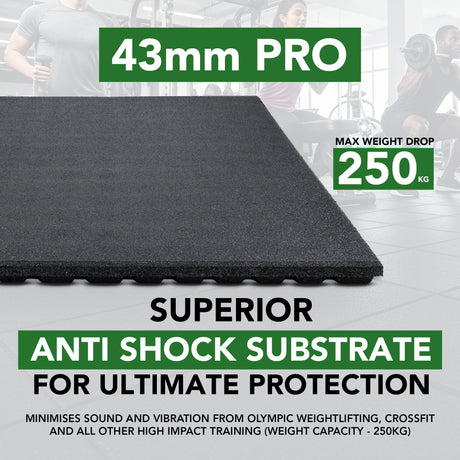
Among rubber gym tiles sold in the last 12 months, 85% were 20mm thick. The extra-thick options — 30mm and 43mm anti-shock tiles built for dropped barbells — accounted for just 7% of tile sales, with thinner 11–15mm tiles making up the remainder.
The pattern reflects how buying advice has matured: rather than covering whole rooms in heavy-duty rubber, buyers increasingly floor the room in 20mm and specify thicker tiles only for the corner where loaded bars actually come down. Roughly one in eight orders also includes finishing edge ramps — the clearest sign that today's home gyms are planned rooms rather than a mat under a bench.
5. The HYROX effect
No force has reshaped UK fitness search behaviour faster than HYROX, the indoor fitness race. UK Google searches for "HYROX" measured a few dozen a month in mid-2020. By January 2023 they had reached roughly 17,000 a month. By March 2026, the monthly peak passed 150,000 searches — a nine-fold increase in three years and one of the fastest-growing fitness terms Britain has ever produced.
The knock-on effect reaches the home: HYROX training rewards functional space — sled lanes, open floor, durable surfaces — and correlates with the growth in garage and garden gym conversions this report records elsewhere. (Sprung Gym Flooring's HYROX statistics hub tracks the sport's growth in detail.)
6. What Britain asks before buying
UK search demand for the category remains substantial: "gym flooring" alone attracts around 8,000–10,000 UK searches a month, "foam mats" around 4,000–5,500, and garage-specific terms ("garage gym flooring", "gym flooring for garage") a combined 1,700+. The fastest-growing questions are practical ones — flooring over carpet, shed and garden gym conversions, and noise reduction for upstairs rooms — reflecting a market that has moved from "should I build a gym?" to "how do I build it properly in the space I have?"
A structural shift sits underneath: fitness questions are increasingly answered by AI assistants rather than ten blue links. Microsoft's Copilot alone cited Sprung Gym Flooring's guides 13,400 times between May and August 2026, most often for questions about interlocking mats, garage flooring and home gym setup — a signal of where category research is moving.
Methodology
Sales figures are drawn from Sprung Gym Flooring's complete UK transaction records, 2020 to August 2026, covering the 55,000+ home gyms supplied since 2020; growth and seasonality figures are expressed as percentages of the company's own volumes. City rankings use order density in the 12 months to August 2026 against approximate ONS mid-year urban population estimates, for cities above a minimum order threshold; figures are rounded. Thickness share is calculated across the 15 best-selling tile products (12 months, order counts). Search volumes are Ahrefs UK data; the HYROX series contains occasional data-collection gaps, which were excluded from trend calculations. AI citation figures are Microsoft Bing Webmaster Tools "AI Performance" data (Microsoft Copilot and partner surfaces, 11 May – 9 August 2026), which Microsoft notes is a sample and therefore a minimum.
Using this data
This report is free to quote and republish with attribution. Cite as: Sprung Gym Flooring, The UK Home Gym Report 2026 — with a link to this page. For the underlying data, regional breakdowns, or comment from founder Richard McKay, contact info@gym-flooring.com.
About Sprung Gym Flooring: founded in Glasgow in 2020, Sprung Gym Flooring (gym-flooring.com) is one of the UK's leading gym flooring suppliers, with more than 55,000 home gyms and 1,500 commercial facilities floored. Rated Excellent on Trustpilot.