The 10-second answer
Choose interlocking tiles if you want the easiest DIY installation and a floor that can be lifted or moved later. Choose standard tiles if you are happy to spend more time on layout, cutting and edge alignment.
Interlocking tiles come in a few different forms - you have tiles with an interlocking profile (like a puzzle edge) or you have premium standard edge tiles with interlocking connection inserts which join together at the base and are not visible. Both options are excellent for home and commercial gyms so it is really down to personal preference, budget and finish.
Standard, straight-edge tiles are usually uniform and come in basic colours such as Black or Grey. They also come in thickness options from 11mm to 63mm. Interlocking options come in a variety of colours, designs and size options but have less thickness options.
Interlocking Choices
- Konnecta interlocking tiles (hidden inserts) come in 10 finishes and are 20mm thick
- Puzzle Gym Tiles - 3 colours/ 4 thicknesses
Quick comparison
| Feature | Interlocking tiles | Standard tiles |
|---|---|---|
| Best for | Premium commercial gym spaces, home gyms, garage gyms | Home gyms, garage gyms and commercial projects |
| Installation | Easiest | More precise |
| Movement resistance | Good because tiles lock together | Good when well compressed or bonded |
| Appearance | Edges may be visible or have a straight edge with hidden inserts | Standard bevel edge finish |
| Repairs | Easy tile replacement | Easy tile replacement |
| Cutting | Simple | Simple |
| Best buyer | User is looking for design choice and easy fitting | User is looking for a plain professional finish |
When interlocking tiles are the right choice

Interlocking tiles are the best option for most home gym customers because they remove uncertainty. The tile edges lock together, which helps the floor feel stable without requiring adhesive in most domestic spaces.
They are particularly useful in garages, spare rooms, garden gyms and rented spaces where the customer might want to move the floor later. They are also easier for customers who are nervous about installation because the tile pattern naturally guides the layout.
For home gym use, we suggest puzzle edge gym tiles which are less expensive or alternatively interlocking tiles that come with hidden inserts if you have a larger budget.
When straight-edge tiles are the right choice

Standard edge gym tiles are the go-to for most gym spaces - home or commercial. They come in a wide range of thicknesses and are fairly easy to install (following guidelines).
They are a strong choice for PT studios, commercial gyms, strength zones, university facilities and leisure sites where the installation may be handled by a contractor. They also work well when a gym wants different thicknesses or colours across different training zones.
Decision shortcuts
| Use case | Best choice |
|---|---|
| Budget home gym | Standard tiles |
| Basic garage gym | Standard tiles |
| Unconfident DIYer | Interlocking tiles |
| Boutique PT studio | Interlocking tiles |
| Commercial strength area | Standard tiles |
| Customer may move the gym later | Interlocking tiles |
| Customer wants quick installation | Interlocking tiles |
Common questions
Do interlocking gym tiles need glue?
Usually not in a home gym, provided the floor is flat and the tiles are properly fitted. Commercial areas may still benefit from adhesive or perimeter fixing depending on traffic and layout.
Do standard tiles move around?
They can if they are loose-laid poorly or they are extremley thin, but a tight fit using compression, suitable edging and adhesive where needed will keep them stable. Also, selecting tiles from approx 11mm upwards means they have sufficient weight to remain sturdy and in position.
Which looks better?
This is dependent on your personal preference to style and aesthetic. Standard tiles are sleek and functional whereas interlocking tiles come in different forms, designs and colours.
Which is better for heavy weights?
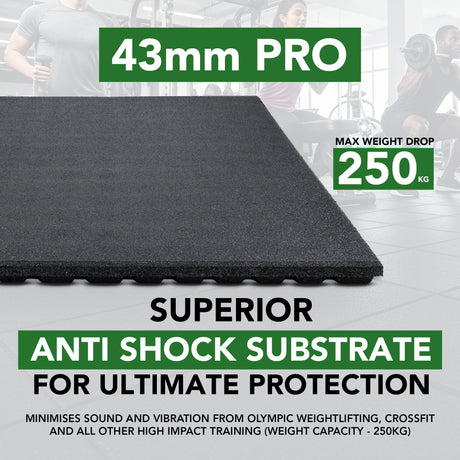
The tile thickness and density matter more than the edge style. For heavy lifting, choose the right thickness first, then choose the edge format. For serious heavy lifting, 30mm and 40mm plus tiles are best which are standard edge tiles.

![20mm Java Black Rubber Gym Flooring Tiles with Recycled Coffee Grounds [Pre-Order] GYM FLOORING Sprung Gym Flooring](http://www.gym-flooring.com/cdn/shop/files/Title_2.png?v=1773994895&width=460)