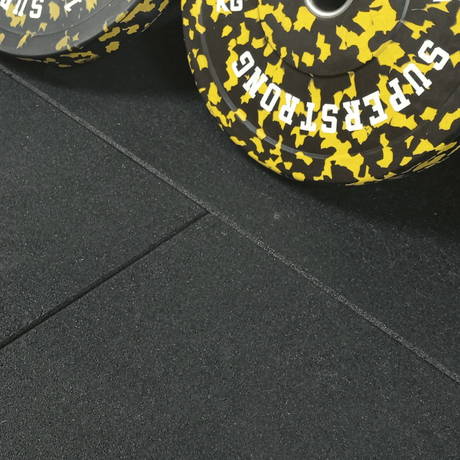
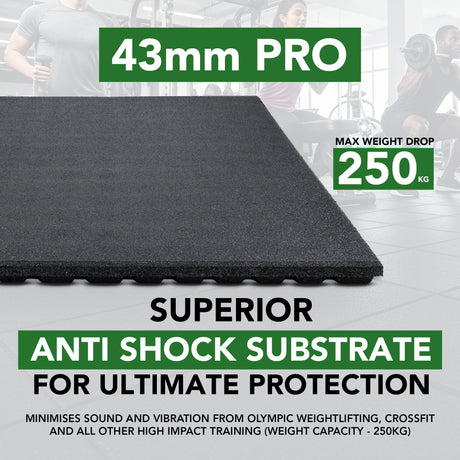
Spend ten minutes on Reddit researching home gym flooring and you'll meet the community's favourite piece of advice: don't buy gym tiles at all — go to a farm supplier and buy horse stall mats instead. It's practically a rite of passage on r/homegym. And here's the awkward thing for a company that sells gym flooring: the advice isn't stupid. It's half right.
We're in an unusual position to referee this one, because we sell both. Gym tiles are our main business; proper rubber stable mats are one of our oldest lines. We genuinely don't mind which one you buy from us — so what follows is the straight answer, including the part where Reddit wins.
Why Reddit recommends horse stall mats

The logic is sound. Stall mats are solid rubber, usually 17–18mm thick, built to survive a 600kg animal wearing metal shoes. A barbell doesn't scare them. They're dense enough for deadlifts, they don't compress like foam, and in the United States — where most Reddit advice is written — they're absurdly cheap. A 6'x4' mat from an American farm store costs around $45–60, which works out at roughly half the price per square foot of branded gym tiles over there.
So when an American Redditor says "just buy stall mats," they're describing a genuine 40–60% saving with barely any downside for a garage gym. For that buyer, it's the correct call, and any flooring company that pretends otherwise is hoping you won't check.
The catch: that advice doesn't cross the Atlantic
Here's what the threads never mention, because almost nobody in them is shopping in the UK: the price gap that makes the hack work barely exists here.
In Britain, a 6'x4' stall mat typically sells for somewhere in the £40–70 range depending on thickness and supplier — call it £20–30 per square metre once you do the conversion. UK gym tiles, meanwhile, don't carry American boutique-brand pricing: our most popular 20mm tiles work out at under £25 per square metre with current offers, delivered free. Run the numbers for your own space and you'll usually find the two options land within a few pounds of each other — sometimes with the tiles cheaper once delivery is included, because a pallet of 45kg mats is not a cheap thing to ship.
The American hack survives on a 50% saving. In the UK, you're often "saving" the price of a takeaway and giving up quite a lot to do it.
Where stall mats genuinely win
Being fair to the hack, there are cases where it's still the right answer:
A rough garage that will only ever be a rough garage. If aesthetics genuinely don't matter, the floor is uneven concrete, and the space doubles as storage for bikes and paint tins, a couple of stall mats under a rack is a perfectly good solution.
A dedicated deadlift corner. One heavy mat that never moves, taking repeated drops in one spot — the mass works in its favour.
Genuinely temporary setups. Renting for six months and taking the gym with you? A mat you can roll a rack onto without any layout planning has appeal.
Where they fall short — the part of the thread nobody upvotes
The weight cuts both ways. A 6'x4' rubber mat weighs 40–50kg. That's brilliant for staying put and miserable for everything else: getting it home, up a flight of stairs, or repositioned once it's down is a two-person job that ends with sore fingers. Gym tiles weigh a few kilos each and one person lays a whole room in an afternoon.
Gaps, curl and walking. Stall mats are made to fill a stable, not tessellate in your spare room. Edges curl, mats "walk" apart under dynamic training, and the gaps collect chalk and grit. Interlocking tiles exist precisely because of this — they lock flat and stay put.
The smell is real. Reddit is honest about this one: recycled rubber off-gasses, and a heavy stall mat in an unventilated spare room can smell industrial for weeks. Quality-controlled gym tiles aren't odour-free on day one either, but the difference in a bedroom-sized space is considerable. (If you're curious why some rubber smells worse than others, our SBR vs EPDM guide covers it.)
Tolerances and finish. Stall mats are agricultural products with agricultural tolerances — thickness can vary a few millimetres across a batch, which a horse never notices and a barbell does. Surface finish, colour consistency and squared edges simply aren't what the product is for.
Cutting and fitting. Rubber this thick fights back. Fitting mats around a rack's feet or an awkward alcove with a Stanley knife is an experience people write regretful posts about afterwards.
No gym credentials. No impact ratings, no acoustic data, no fire classification, no warranty that contemplates a gym. Irrelevant in your own garage; a dealbreaker the moment the space is commercial, insured, or shared.
What Reddit gets right about tiles, too
The same threads contain a second piece of advice we'll also co-sign: don't overpay. You do not need 30mm+ tiles across an entire home gym, whatever a premium brand's marketing says. For general training, 20mm of quality rubber is plenty. Save the thicker tiles for where you actually drop loaded bars — a deadlift or Olympic lifting zone — and spend the difference on plates. Reddit's scepticism about flooring upsells is healthy; it just shouldn't tip into buying farm equipment to avoid them.
The honest comparison

Horse stall mats: UK price roughly £20–30 per square metre; 40–50kg per mat, a two-person job; gaps, curl, and mats can walk; often a strong smell at first indoors; agricultural tolerances; utilitarian looks; excellent under drops and deadlifts; no gym warranty or ratings.
20mm gym tiles: roughly £23–33 per square metre (less in offers); light, one-person install; interlocked, flat, stays put; milder smell that settles faster; uniform thickness and finish; clean looks with colour options; excellent under drops (30mm+ where you drop); warranty and ratings included.
So which should you buy?
If you're kitting out a rough garage on the tightest possible budget, don't care about looks or smell, and have a mate to help carry — the Reddit hack still works, and we'll happily sell you the stable mats to do it.
For almost everyone else in the UK, the maths that powers the advice simply isn't there. For the price of a curry over the stall-mat option you get flooring that one person can lay, that fits the room, locks flat, smells acceptable in the house, and comes with a warranty — which is why our tiles outsell our stable mats for home gyms about fifty to one, from a company happy to sell either.
Reddit's instinct — refuse to overpay for rubber — is exactly right. In Britain, the way to act on it is 20mm tiles for the room, thicker tiles only where the bar comes down, and the stall mats left to the horses.
FAQs
Are horse stall mats safe for a home gym?
Structurally, yes — they're dense, stable under racks, and handle dropped weights well. The compromises are practical rather than safety-related: weight, fit, smell and finish.
Do horse stall mats smell?
Usually, yes — recycled rubber off-gasses, and it's noticeably stronger in enclosed indoor rooms than in a stable or open garage. It fades over weeks. Ventilation and a mild soap wash help.
What thickness do I need for deadlifts?
20mm handles general lifting comfortably. If you're regularly dropping loaded bars from height, use 30mm or more in that zone — you don't need it across the whole floor.
Can I mix stall mats and gym tiles?
Yes, and it's sometimes the smart budget play: a stall mat or thick tile platform in a dedicated drop zone, interlocking 20mm tiles everywhere you actually walk and train.

![20mm Java Black Rubber Gym Flooring Tiles with Recycled Coffee Grounds [Pre-Order] GYM FLOORING Sprung Gym Flooring](http://www.gym-flooring.com/cdn/shop/files/Title_2.png?v=1773994895&width=460)