You've stood outside a gym door before, haven't you? Maybe sat in the car park for ten minutes scrolling your phone. Talked yourself into going in, then talked yourself back out.
If you have, you're not soft. You're not weak. You're one of the millions of people who experience what's now called gymtimidation — the very real anxiety of working out in a public space surrounded by strangers, mirrors, grunting, and equipment you're not sure how to use.
It's such a common thing that it has its own name. And the data backs it up: in one widely cited UK survey, 50% of people said they'd avoided going to the gym because of how it made them feel, and roughly half of women reported feeling intimidated by the free weights area specifically (FitRated, 2019). Younger gym-goers feel it most — Gen Z report the highest rates of gym-related anxiety of any age group.
This post is about what's actually going on, why public commercial gyms struggle to fix it, and why building a small, safe space at home or in the garage might be the most underrated mental health move you can make this year.
What Gymtimidation Actually Feels Like

It's rarely one big thing. It's a stack of small ones:
- Walking past the squat rack and worrying you're using the wrong technique
- Catching your reflection in the mirror and freezing
- The bloke who hovers waiting for "your" machine
- Someone filming a workout and you're accidentally in the background
- Not knowing if a piece of kit is free or if someone's "got a set on it"
- The feeling that everyone else knows what they're doing and you don't
Researchers call this social physique anxiety — the worry that other people are evaluating your body. It's been studied since the late 80s, and it predicts gym avoidance better than almost any other factor (Hart, Leary & Rejeski, Journal of Sport & Exercise Psychology).
The cruel irony is the people who'd benefit most from training — beginners, older adults, anyone returning after illness, injury, or pregnancy — are the same people most likely to feel out of place when they walk in.
Why Commercial Gyms Can't Really Solve This

Big-box gyms have tried. "Judgement-free zones." Women-only floors. Lunk alarms. Beginner inductions. Some of it helps. But the fundamental design problem doesn't go away:
A commercial gym is a shared space optimised for throughput. Hundreds of people, dozens of pieces of kit, mirrors everywhere, music you didn't choose, lighting that's always too bright or too dim. You don't control any of it.
For a confident lifter that's fine — even energising. For someone managing anxiety, peri-menopause symptoms, body image issues, or just a brutal week at work, it's the opposite of what their nervous system needs to actually train well.
The Quiet Rise of the Home Gym

UK home gym ownership roughly doubled during the pandemic and hasn't dropped back. According to Mintel's UK fitness reports, a meaningful share of the adult population now trains primarily at home, and home equipment spending has stayed elevated well past lockdowns ending.
Some of that is convenience. Some of it is cost — you can pay off a serious home setup in a couple of years of cancelled memberships. But a lot of it, talking to customers, is something quieter: people just feel better training in a space that's theirs.
You don't need a basement palace. The most-used home gyms we see at gym-flooring.com are 3m x 3m garage corners with a rack, a barbell, a bench, and good workout flooring. That's it. That's enough.
Why the Floor Is the First Thing That Matters
This is the part most people get backwards. They buy the rack first, the bar second, the plates third — and the flooring last, usually as an afterthought when the concrete starts marking up the bumpers.
In reality, the floor is what makes the room feel like a gym instead of a shed with weights in it. And it's the single biggest factor in whether you'll actually use the space.
Here's why:
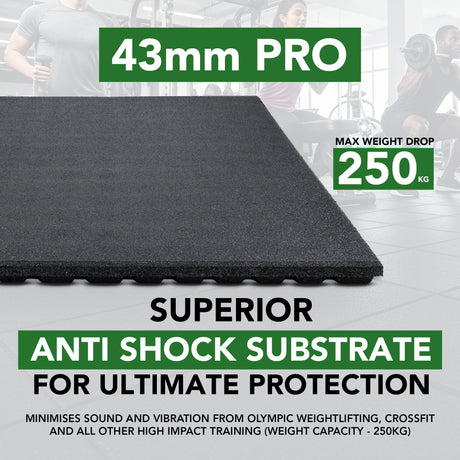
It protects your joints. Concrete and tile are punishing. Even bodyweight work — burpees, lunges, jumping — adds up. A proper rubber surface (15mm or thicker for free weights, 30–43mm for serious lifting) absorbs impact in a way that lets you train more often without the niggles that quietly kill consistency.
It protects the building. Dropped 100kg deadlifts on a bare garage floor will eventually crack the slab. They'll definitely shake the house. Premium rubber gym flooring isolates the impact and saves you a much bigger bill later.
It manages noise. This is the unspoken one. If you train at 6am or 10pm, the difference between "I can drop the bar" and "I have to lower it carefully every rep" is your floor. Noise is one of the top reasons home gym owners stop using their setup — they feel watched and judged in their own house.
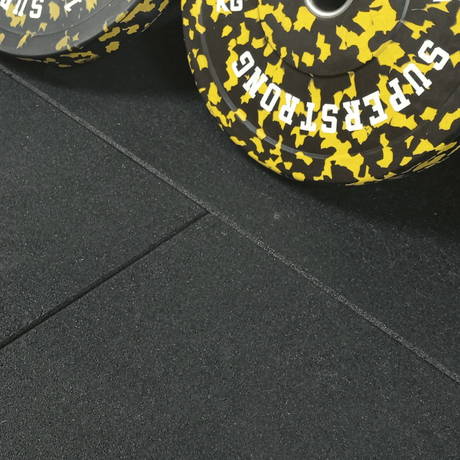
And — here's the bit nobody talks about — it changes how the room feels. Walk into a garage with bare concrete and one of those dimpled black mats from a DIY shop and your brain registers "storage." Walk into the same space with proper interlocking rubber tiles, edge ramps, and clean lines and your brain registers "gym." That mental shift is the difference between training and not training.
Building a Genuinely Safe Space at Home
A few things we've learned from kitting out thousands of UK home gyms:
Start with the floor area, not the equipment list. Measure your space. Decide what zone is for lifting (heaviest impact, thickest tiles), what's for cardio or mobility (thinner is fine), and what's a buffer zone. Most people overestimate how much rack space they need and underestimate how much clear floor they want.
Lighting and mirrors are mental health kit, not vanity items. Warm, bright, even lighting changes how a basement or garage feels. A single full-height mirror lets you check form without filming yourself. Both reduce the "I'm in a cave" feeling that quietly kills motivation.
Sound matters more than you think. A small Bluetooth speaker, your own playlist, your own podcast — the absence of someone else's music is a genuine relief if you've trained in commercial gyms for years.
Don't aim for Instagram. Aim for "I'd happily train here at 6am in pyjamas." That's the actual test. If the answer is yes, the space is working.
Build it in stages. Floor first. Rack and barbell second. Plates as you progress. Accessories last. People who try to buy the whole gym in one go often spend more and use it less than people who build it over six months.
What This Has to Do With Mental Health

A safe training space is more than a fitness tool. For a lot of people it becomes a kind of decompression chamber — the place you go when work has been too much, when the kids have been climbing the walls, when you need 45 minutes of just barbell, breath, and your own thoughts.
You can't replicate that in a public gym. There's always a queue, always a stranger, always a reason to cut it short.
If gym anxiety has been keeping you from training — or keeping someone you love from training — the answer probably isn't "try harder to push through it." It might just be a small, well-designed space at home where you don't have to push through anything.
You don't need a lot of room. You don't need a lot of kit. You need a proper floor, decent light, and the freedom to be a beginner in private until you don't feel like one anymore.
At Sprung Gym Flooring we've helped over 46,000 customers build home and garage gyms across the UK. If you're starting from scratch and want help working out what flooring you actually need for your space, drop us a line — we'll send you samples and tell you straight if you're over- or under-speccing.
Browse our home gym flooring range →
Frequently Asked Questions
Is gymtimidation a real thing or just an excuse? It's a real, well-documented phenomenon. Researchers call it social physique anxiety, and surveys consistently find around half of UK adults have avoided the gym because of how it made them feel.
Can a home gym actually replace a commercial gym? For most people training for general health, strength, and conditioning — yes, easily. A 3m x 3m space with a rack, barbell, bench, and good flooring covers 90% of what a commercial gym offers, minus the queues and self-consciousness.
What's the minimum flooring I need for a home gym? For bodyweight and light dumbbell work, 15mm rubber tiles are enough. For barbell training and dropping plates, go 30mm or thicker, and add a dedicated lifting platform area if you can.
How much space do I need for a home gym? You can build a serviceable home gym in as little as 2.5m x 2.5m. For a full power rack with barbell clearance, 3m x 3m is comfortable. More is nice but rarely necessary.
Will a home gym help with gym anxiety? For many people, yes — significantly. Removing the social, sensory, and logistical friction of a public gym makes consistent training far more likely, which is where every other benefit comes from.