The 10-second answer
Rubber for free weights, commercial gyms, and anything where weights get dropped. Foam for low-impact, soft-surface training — martial arts, yoga, kids' areas. Vinyl for multi-use sports halls where appearance and cleanability matter more than impact protection.
If you only read one line: most home and commercial gyms want rubber. Foam and vinyl are for specific cases, not defaults.
Quick comparison
| Rubber | Foam (EVA) | Vinyl | |
|---|---|---|---|
| Best for | Free weights, commercial gyms, HYROX, mixed-use | Martial arts, yoga, boxing, kids' zones | Sports halls, studios, multi-use leisure |
| Impact protection | Excellent | Low–moderate | Low |
| Drops heavy weights? | Yes | No | No |
| Underfoot feel | Firm, supportive | Soft, cushioned | Firm, hard |
| Typical thickness | 6–60mm | 20–40mm | 2–8mm |
| Water/sweat resistance | High (naturally water-resistant) | Moderate | High |
| Durability | 10+ years | 2–5 years | 5–10 years |
| DIY install | Tiles/rolls — straightforward | Easiest (puzzle edges) | Usually needs fitting |
| Relative cost | Higher upfront, best value long-term | Lowest upfront | Mid |
When rubber is the right choice

Choose rubber if any of these apply:
- You drop or lift free weights (dumbbells, barbells, kettlebells)
- It's a commercial gym, studio, or PT space taking daily traffic
- You need to protect a concrete or joisted subfloor from impact
- You're fitting a HYROX, CrossFit-style or functional zone
- You want a floor that lasts a decade-plus
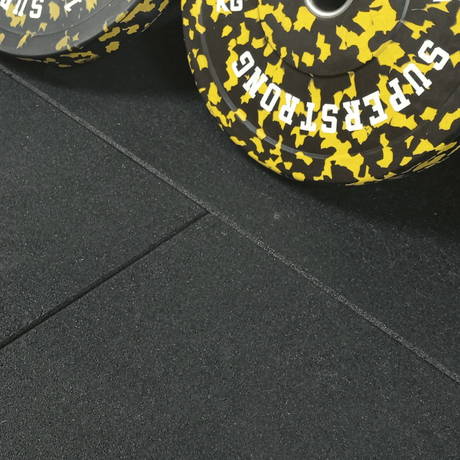
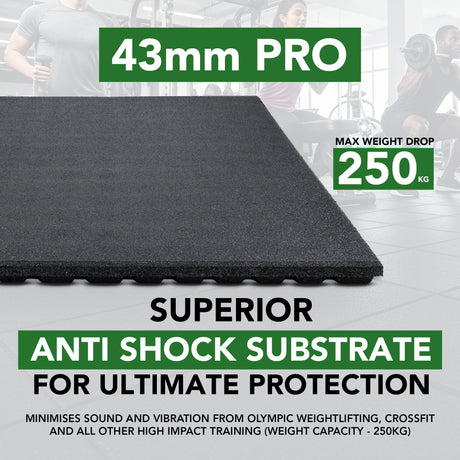
Why: rubber is the only one of the three engineered to absorb dropped-weight impact and survive heavy daily use. It's water-resistant, low-maintenance, and comes in thicknesses from 6mm cardio rolls up to 60mm platform tiles.
Not ideal when: you need a genuinely soft surface (martial arts, floor work) or you're on the tightest possible budget for a light-use space.
When foam is the right choice

Choose foam if any of these apply:
- You're doing martial arts, boxing, MMA, or wrestling
- The space is for yoga, Pilates, stretching, or mobility
- It's a kids' play or activity area
- You want the cheapest, fastest DIY option for light use
Why: EVA foam gives a soft, cushioned, friction-free surface that protects the body during floor work — not the floor from weights. Puzzle-edge tiles fit in minutes with no specialist tools.
Not ideal when: you lift free weights. Foam compresses and tears under dropped weights and won't protect your subfloor.
When vinyl is the right choice

Choose vinyl if any of these apply:
- It's a multi-use sports hall or leisure centre
- Appearance, line-marking and easy cleaning matter most
- The space sees footfall and light activity, not weight training
Why: vinyl is hygienic, hard-wearing underfoot traffic, and looks clean in shared facilities. It's a sports-hall surface, not a weights surface.
Not ideal when: weights are involved. Vinyl damages easily under impact and offers little shock absorption.
Decision shortcuts by use case
- Home gym, free weights → Rubber, 15–30mm tiles or rolls
- Home gym, heavy lifting (140kg+) → Rubber, 30–60mm platform
- Home gym, cardio only → Rubber, 6–12mm rolls
- Commercial gym → Rubber throughout, zoned by thickness
- Yoga / Pilates / HIIT studio → Foam 20–40mm, or light rubber
- Martial arts / boxing → Foam (tatami) 20–40mm
- Sports hall / leisure centre → Vinyl
- Kids' activity area → Foam
Common questions
Can I use foam for a home gym?
Only for low-impact training. If you lift free weights, foam won't protect your subfloor or survive dropped weights — choose rubber.
Is rubber or foam better for joints?
For impact-heavy work, thick rubber absorbs force best. For floor-based work where you're in direct contact with the surface, foam feels softer.
What thickness do I need?
Cardio: 6–12mm rubber. General free weights: 15–30mm rubber. Heavy/Olympic lifting: 30–60mm rubber. Foam for comfort: 20–40mm.
Which lasts longest?
Rubber, comfortably — 10+ years in commercial use. Foam is 2–5 years; vinyl 5–10.
Sprung has supplied gym flooring to 53,000+ customers since 2020, including Manchester City's training ground, Google HQ, and the Glasgow 2014 Commonwealth Games.