Picking the wrong thickness is one of the most common and costly gym flooring mistakes. Too thin and your subfloor pays the price. Too thick and you've overspent on protection you'll never need.
This guide cuts through the confusion with a direct 20mm vs 30mm gym flooring comparison — specs, pricing, use cases, and a clear recommendation for every gym type.
Quick Answer
20mm gym tiles handle around 90% of home and commercial gym needs, with a maximum drop weight of 140kg — covering dumbbells, kettlebells, standard barbells, and functional training in full. 30mm gym tiles are purpose-built for dedicated heavy lifting zones, CrossFit boxes, and commercial facilities where barbell drops above 140kg are routine, with a maximum drop weight of 200kg.
For most home gym owners and boutique studio operators, 20mm is the right call. If you're running a powerlifting facility or a high-volume CrossFit box, read on — the case for 30mm (or a zoning strategy that combines both) becomes clear quickly.
20mm Gym Flooring — Overview

The 20mm Sprung PRO is Sprung's most popular tile, rated 4.9/5 across 543+ reviews and trusted in over 52,000 customer installs across the UK. It's the benchmark for home gym flooring thickness — robust, easy to install, and genuinely long-lasting.
Key specs at a glance:
- Price: £32.95/m²
- Max weight drop: 140kg
- Material: 100% recycled SBR rubber (70% truck tyres + PU binder), 950–1,000 kg/m³ density
- Shock absorption: 70–80%
- Noise reduction: ~15–20dB
- Fire classification: Efl S1
- Hardness: 55–75 Shore A
- Certification: REACH & CE
- Warranty: 4 years
- Dispatch: Next-day on stocked items
Best suited to: Home gyms, garage setups, PT studios, hotel gyms, boutique fitness studios, dumbbell training areas, kettlebell zones, functional fitness spaces, and general strength training environments.
Installation: The standard 20mm PRO uses a bevel edge, lay-flat format — no adhesive needed. Tiles interlock through a butt-joint system, making it a straightforward DIY installation. For a fully interlocking format, the 20mm Sprung PRO Interlocking is available at £44.99/m², with connection inserts included for a tighter, more permanent fit.
Lifespan: 15+ years in home use; 8–10 years under commercial traffic.
The 20mm PRO is built to absorb the day-to-day demands of any gym that isn't regularly dropping loaded barbells from above knee height. It protects concrete subfloors effectively, deadens noise, and holds its shape under consistent load. For the vast majority of training environments, it's everything needed.
30mm Gym Flooring — Overview

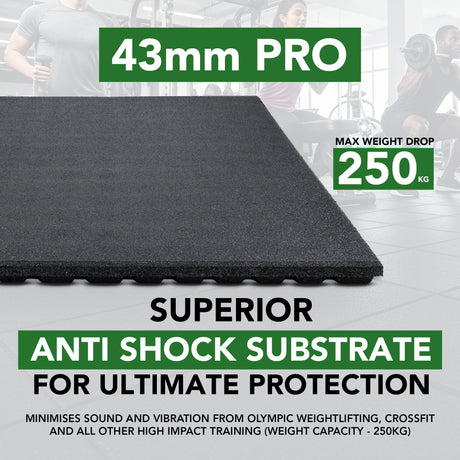
The 30mm Sprung PRO is engineered for the highest-impact training environments. Where the 20mm handles standard training, the 30mm is built specifically to absorb repeated, heavy barbell drops — the kind of punishment found in CrossFit boxes, powerlifting gyms, and commercial heavy lifting zones.
Key specs at a glance:
- Price: £68.89/m²
- Max weight drop: 200kg
- Material: 100% recycled SBR rubber with stud underside for anti-shock performance
- Shock absorption: 85–90%
- Noise reduction: ~25dB
- Density: 950–1,000 kg/m³
- Warranty: 4 years
- Lead time: 7–10 working days (non-stock, made to order)
Best suited to: CrossFit boxes, dedicated deadlift and Olympic lifting zones, commercial powerlifting facilities, and any area where barbell drops above 140kg are a regular part of programming.
The stud underside is the key structural difference. It creates a compression channel beneath the tile surface, giving the rubber more direction to deform under impact — meaning more energy is absorbed, less is transferred to the subfloor, and noise transmission drops significantly compared to the 20mm. At ~25dB noise reduction, it's meaningfully quieter under heavy use, which matters for shared buildings, apartment blocks, or multi-use facilities.
Important: The 30mm Sprung PRO is a made-to-order product with a 7–10 working day lead time. Factor this into planning timelines for commercial installs or gym builds.
Side-by-Side Comparison Table
| Feature | 20mm Sprung PRO | 30mm Sprung PRO |
|---|---|---|
| Price per m² | £32.95 | £68.89 |
| Max Weight Drop | 140kg | 200kg |
| Shock Absorption | Good (70–80%) | Superior (85–90%) |
| Noise Reduction | 15–20dB | 25dB |
| Tile Weight | ~20kg | ~30kg |
| Best For | Home, boutique, PT studios | CrossFit, commercial, heavy lifting |
| Subfloor Protection | Excellent | Maximum |
| Installation | DIY-friendly | Heavier — may need help |
| Lead Time | Next-day dispatch | 7–10 working days |
| Lifespan (home) | 15+ years | 15+ years |
| Lifespan (commercial) | 8–10 years | 10+ years |
| Warranty | 4 years | 4 years |
| Material | 100% recycled SBR | 100% recycled SBR + stud underside |
| Certification | REACH & CE | REACH & CE |
Best for Home Gyms

For the overwhelming majority of home gym setups, 20mm is the right choice — and the numbers back it up.
The 20mm Sprung PRO at £32.95/m² comfortably handles:
- Dumbbells up to ~60kg dropped from bench height
- Standard barbells loaded for squats, bench press, rows, and overhead work
- Kettlebell swings, drops, and slams
- Functional training, plyometrics, and cardio equipment
- Rack-mounted plates and general strength training
The only scenario where a home gym owner should consider upgrading to 30mm is if deadlifts regularly exceed 150kg and the bar is being dropped (rather than lowered) from above knee height with any frequency. That's a specific use case — most home lifters, even serious ones, don't meet that threshold consistently enough to justify the additional cost.
The price difference is real: £32.95/m² vs £68.89/m² means a typical 15m² home gym costs around £494 in 20mm versus roughly £1,033 in 30mm. The extra £539 buys protection most home gyms will never need.
For home gym owners who want more colour or a tighter interlock system, the Konnecta Fleckz 20mm tiles offer a premium aesthetic in six colours at £94.34/m², with self-locking joints.
Verdict for home gyms: Go 20mm. Save the difference.
Best for Commercial Gyms

Commercial gyms operate across a wider range of activities, intensities, and user profiles — which means a single thickness is rarely the optimal solution.
The recommended approach for commercial facilities is a zoning strategy:
- 20mm Sprung PRO across the main training floor — cardio zones, functional fitness areas, stretching and bodyweight zones, machine areas, and dumbbell zones up to 140kg
- 30mm Sprung PRO in dedicated heavy lifting zones — Olympic lifting platforms, deadlift zones, and CrossFit drop areas
This approach protects the highest-impact areas with maximum-grade flooring while keeping costs under control across the broader floor space. A commercial gym running 20mm across 200m² and 30mm across a 30m² lifting zone, for example, is spending approximately £9,173 — versus £14,745 if the entire 230m² is laid in 30mm. The zoning strategy saves over £5,500 without compromising protection anywhere that matters.
For standalone CrossFit boxes or powerlifting-only facilities where heavy barbell drops occur across the entire floor, 30mm throughout is the right specification. The 25dB noise reduction and 200kg drop capacity are non-negotiable in those environments.
Browse the full commercial gym flooring collection for the complete range of commercial-grade options.
When to Mix Thicknesses

The zoning approach — 20mm across the main floor with 30mm in heavy lifting areas — is one of the most cost-effective strategies in commercial gym design, and it works for larger home gyms too.
How it works in practice:
- Lay 20mm Sprung PRO across the majority of the floor as the base
- Define your dedicated lifting zone (Olympic platform, deadlift area, drop zone)
- Install 30mm Sprung PRO in those areas specifically
- Address the 10mm height difference between zones using edge ramps or transition strips — this is entirely manageable and is standard practice in commercial builds
The 10mm step between thicknesses is small enough to be safe underfoot and is easily mitigated with bevelled edge strips. In most cases, members don't notice it at all, particularly when the zones are clearly defined by colour or layout.
For a facility planning this approach, using the flooring calculator to estimate quantities for each zone separately gives the most accurate cost picture. The commercial gym flooring collection covers everything needed for a mixed-specification install.
Cost Comparison
The price gap between 20mm and 30mm gym flooring grows significantly as the floor area increases. Here's what the difference looks like across common room sizes:
| Room Size | 20mm PRO Total | 30mm PRO Total | Saving with 20mm |
|---|---|---|---|
| 10m² | £329.50 | £688.90 | £359.40 |
| 20m² | £659.00 | £1,377.80 | £718.80 |
| 50m² | £1,647.50 | £3,444.50 | £1,797.00 |
Notes on ordering:
- Free delivery on orders over £250 — both products qualify for most room sizes
- Finance available via iwocaPay: split the cost into three interest-free instalments, with no credit checks for amounts under a set threshold
- 30-day money-back guarantee on all Sprung products
- The 30mm PRO requires a 7–10 working day lead time, so factor this into project timelines — it cannot be dispatched next day
For larger commercial installs, the zoning strategy outlined above remains the most cost-efficient approach. Combining 20mm across the main floor with 30mm only in the heavy lifting zones brings the blended cost per m² well below the full-30mm price, while maintaining the right level of protection in every area.
Use the flooring calculator to get an accurate quote for your exact floor size and thickness mix.
The Bottom Line
The 20mm vs 30mm gym flooring decision comes down to one question: are heavy barbells being dropped from height on a regular basis?
If the answer is no — choose the 20mm Sprung PRO at £32.95/m². It covers home gyms, PT studios, hotel gyms, boutique facilities, and the general training floor of any commercial gym. It's trusted by over 52,000 customers, rated 4.9/5, and built to last 15+ years in home use.
If the answer is yes — choose the 30mm Sprung PRO at £68.89/m² for your heavy lifting zones, or throughout if the entire facility is high-impact. The extra protection is genuine, the noise reduction is measurable, and it's the specification CrossFit boxes and powerlifting facilities rely on.
For commercial builds, use both. Zone the floor, protect what matters, and spend the savings on the equipment that fills it.
Ready to order? Use the flooring calculator to work out exactly how much you need, then head to the commercial gym flooring collection or the individual product pages to get started. Free delivery on orders over £250. Finance available via iwocaPay.
Ready to choose your gym flooring?
Use the flooring calculator to work out exactly how much you need, or browse Sprung's commercial gym flooring options to compare products.
Use the Flooring Calculator