The 10-second answer
Choose 15mm for light-to-medium home training and equipment areas. Choose 20mm for general free weights and mixed-use gyms. Choose 30mm+ for heavier lifting, commercial strength zones and impact protection.
Quick comparison
| Thickness | Best for | Avoid if |
|---|---|---|
| 11–15mm | Cardio, equipment, light dumbbells, general home gyms | You regularly drop heavy weights |
| 20mm | General free weights, PT studios, mixed training | Strength training or repeated heavy drops |
| 30mm | Heavy home gyms, commercial lifting zones | You only need light cardio flooring |
| 43–63mm | Platforms, very heavy lifting, high-impact zones | Budget or floor height is limited |
When 15mm gym flooring is enough

15mm rubber gym flooring is a good choice for customers who want a durable, supportive gym floor but are not doing repeated heavy drops.
It suits home gyms with treadmills, bikes, rowers, benches, dumbbells, kettlebells and moderate strength training. It is also a useful option where the customer wants better protection than a thin roll but does not need the depth or cost of a heavy lifting tile.
15mm gym flooring has an overall weight capacity of 110kg.
When 20mm gym flooring is the safer all-rounder

20mm is often the best recommendation when the customer is unsure. It gives more reassurance than 15mm and suits a wider range of mixed training.
For home gyms and PT studios, 20mm is usually a strong balance between cost, comfort, durability and protection. It is thick enough for general free weights, but not so thick that it feels excessive in a mixed-use room.
20mm has an overall weight drop of 140kg
When 30mm+ gym flooring is the right choice

30mm and above or the antishock range, is for those who require high impact protection. This includes heavier dumbbell areas, squat racks, deadlift stations, Olympic lifting, CrossFit-style training and commercial strength zones.
The thicker the tile, the more it helps spread impact, reduce noise and protect the subfloor. It also gives confidence that the floor has been chosen for the worst activity in the room, not the easiest.
- 30mm tiles - overall weight capacity of 200kg
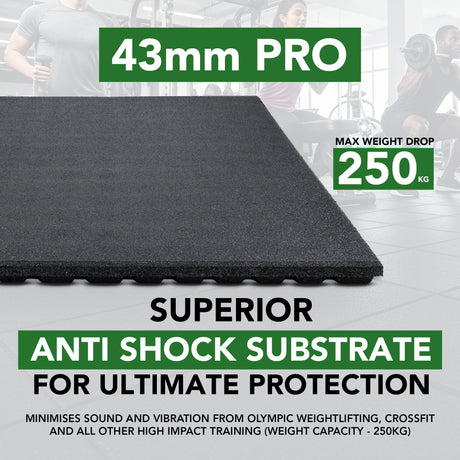
- 43mm tiles - overall weight capacity of 250kg
- 53mm tiles - overall weight capacity of 300kg
- 63mm tiles - overall weight capacity of 350kg
Decision shortcuts
| Training type | Recommended thickness |
|---|---|
| Treadmill, bike, rower | 6–15mm depending on format |
| Light dumbbells | 11mm -15mm |
| General home gym | 15–20mm |
| PT studio | 20mm |
| Free-weight area | 20–30mm |
| Deadlifting | 30mm+ |
| Olympic lifting | 43mm+ or platform-style solution |
| Commercial strength zone | 30–63mm depending on use |
Common questions
Is 15mm gym flooring thick enough?
Yes, for light-to-medium training, cardio equipment and general home gym use. It is not the best choice for repeated heavy drops.
Is 20mm better than 15mm?
20mm gives more protection and is a safer all-rounder for free weights. The quality is the same but the level of impact is greater, the thicker the tile.
Do I need 30mm gym flooring?
You need 30mm or thicker if weights are dropped regularly or the space is used for heavier strength training.
Can flooring be too thick?
Yes. Very thick tiles can be unnecessary for cardio-only spaces and may create threshold or door-clearance issues.